
The SKU consolidation playbook for bloated Shopify stores
By Nimitt Bhatt · 7 June 2026 · 10 min · Updated 20 July 2026
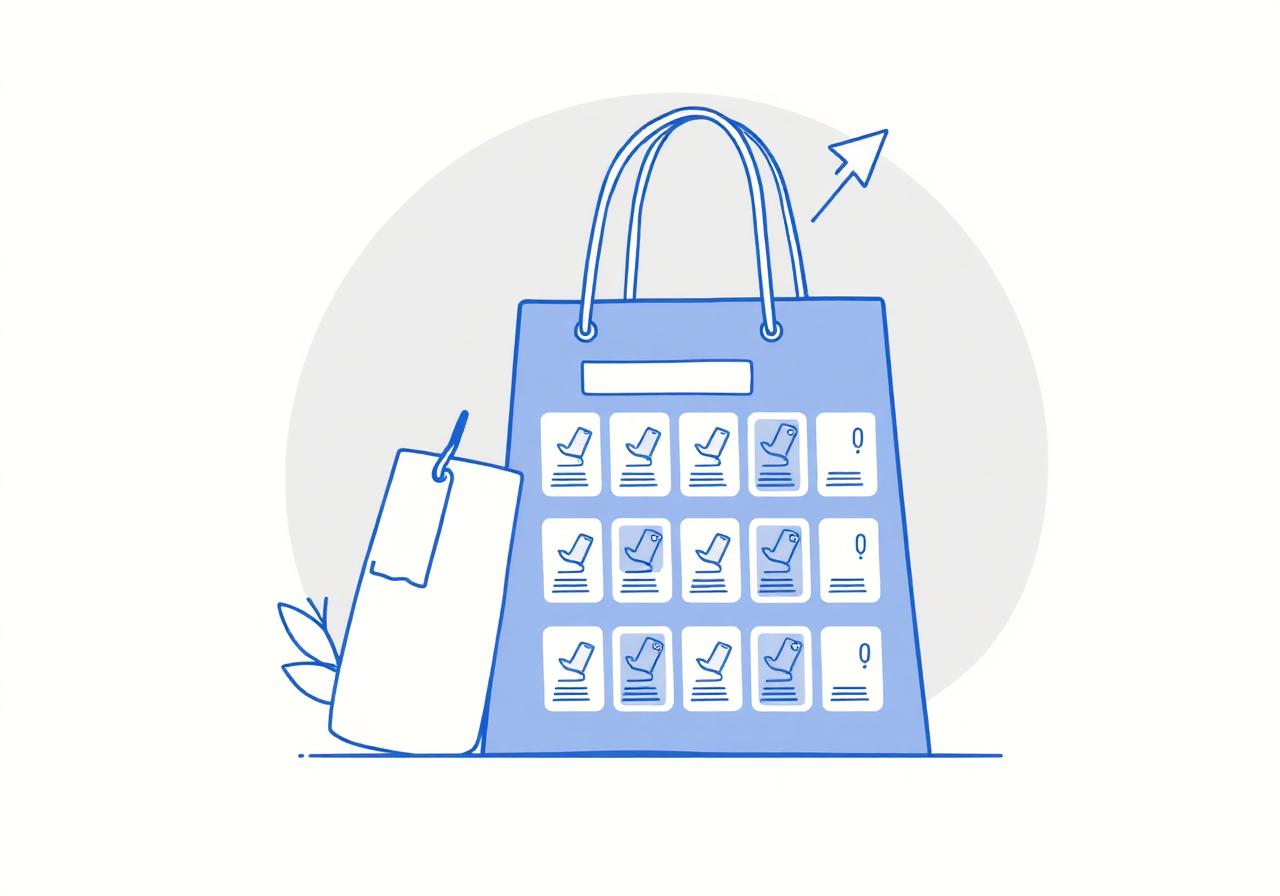
Almost every Shopify store past its second year of growth is quietly carrying the same problem. Three or four versions of the same product, the same t-shirt in a dozen colours split across separate URLs, discontinued SKUs still indexable from 2022, and collection pages built to please a merchandiser rather than a buyer. Google sees a bloated catalog with no clear canonical, buyers see too many almost-identical results, and the store's own internal linking is being spent on URLs that will never earn a sale.
SKU consolidation is the unglamorous fix that reclaims all of it. It is not a rebrand, not a redesign, and not a new content push. It is a hard look at the catalog, followed by disciplined 301 redirects, canonical cleanup and internal link surgery. On the D2C engagements we run in India, it is consistently one of the top three revenue moves available.
The five symptoms of a bloated catalog
- →Multiple product URLs ranking simultaneously for the same query, and none of them in the top three. This is classic cannibalisation. Google is splitting the vote across your own pages.
- →Variants exposed as separate URLs when Shopify already handles them as options on a single product. Colour swatches and size selectors do not need their own indexable pages.
- →Discontinued or out-of-stock products left indexable for years, some still ranking on brand queries, all of them wasting crawl budget and confusing the freshness signal on the category.
- →Collection pages with fewer than five active products each. These are thin by definition and rarely rank. They should either be merged, seasonally hidden, or filled out.
- →A product feed submitted to Google Merchant Center that is 40 percent larger than the number of SKUs you actually sell. That is a direct measure of how much of the catalog is dead weight.
Why bloat quietly costs money
Every URL in your store is a promise to Google that this page is distinct and worth crawling. When a large share of the catalog is near-duplicate or dead, Google slows down the crawl rate on the whole domain. Your new products take longer to index. Your best-selling product pages get re-crawled less often, so seasonal price changes and stock updates lag. Rankings on the pages that do matter drift because internal PageRank is being distributed across URLs that will never sell anything.
The revenue cost is real but hard to see, which is why the problem persists. Nobody gets fired for adding SKUs. People do get nervous about removing them.
The consolidation workflow, step by step
- →Crawl the full store with Screaming Frog or Sitebulb. Export every URL segmented by template: product, collection, blog, tag, filter. Nothing else in the workflow works without this baseline.
- →Pull 12 months of Search Console data at URL level. Every product URL gets tagged with clicks, impressions and top query. Zero-click URLs are candidates for consolidation. High-click URLs are protected canonicals.
- →For every duplicate cluster (same product across colours, sizes, editions), pick one canonical based on GSC performance, not gut feel. The URL with the most existing organic clicks wins.
- →301-redirect every loser to its canonical. Never delete a product URL without a redirect. That is where most stores lose ranking equity overnight.
- →Update internal linking across collections, cross-sells, editorial and navigation so links now point to the canonical, not the redirected loser. Redirects that pass through hops leak equity.
- →Re-issue the XML sitemap with only URLs you genuinely want indexed. Every sitemap entry is a hint to Google about priority.
- →Request re-indexing on the top 50 canonicals via GSC's URL Inspection tool. Do not spam it, do not automate it beyond the daily quota.
- →Monitor GSC and GA4 for 60 days. Rankings will wobble in weeks two and three. Do not panic-revert. Prune the next layer only after the first wave has stabilised.
What to never do
- →Bulk delete products without a redirect plan. You will lose ranking equity overnight and it does not come back.
- →Redirect every retired product to the homepage. Google explicitly treats this as a soft 404 and drops the equity anyway.
- →Consolidate without checking GSC for the queries each loser ranks on. Sometimes the loser is quietly the best-performing URL on a query you did not track.
- →Use canonical tags in place of redirects when the URL is truly dead. Canonicals are a hint. Redirects are a directive. For discontinued SKUs you want the directive.
- →Ship consolidation on a Friday. Ship it on a Monday morning so you have four working days to catch anything that breaks in real time.
"Every URL in your catalog is a promise to Google. Stop making promises you do not intend to keep."
A real pattern from an Indian D2C brand
A homegrown lifestyle brand we worked with had 1,800 active product URLs across the Shopify catalog. Twelve months of GSC data showed only 220 URLs carried any meaningful organic traffic. Another 300 were dead but linked from collections and navigation. The rest were near-duplicates from variant expansion and long-discontinued SKUs. We consolidated to a tight 480 URLs, redirected 900 losers with clean 301s, rebuilt internal linking across collections, and re-issued the sitemap.
The first 21 days looked ugly on the ranking dashboard. Weeks four to eight it stabilised. By day 90, organic revenue from product pages was up 38 percent on a smaller catalog, average position on the top 50 commercial queries was up 4.2 spots, and new products were indexing in hours instead of days. Less, in this case, was unambiguously more.
The audit cadence that keeps it clean
Consolidation is not a one-time project. Growing stores accumulate bloat again. The healthy cadence is a full audit every six months for a store adding under 50 SKUs a month, and a quarterly audit when the SKU rate is higher. Between audits, a lightweight monthly check on GSC for new zero-click URLs and stale product templates is enough to catch drift before it compounds.
Where this connects
We run this work as part of our e-commerce SEO programme. For the category-level thinking, read category page is the highest-impact SEO surface for D2C. For the schema layer that helps consolidated pages earn AI Overview and rich-result eligibility, see collection page schema for D2C. For sites over 10,000 URLs where consolidation is only half the story, the indexation triage workflow for a 50,000 URL site is the next read.
Frequently asked questions
- Will consolidating SKUs hurt rankings in the short term?
- If consolidation is done with clean 301s and internal link updates, rankings typically stabilise within 30 to 45 days and improve thereafter. Done sloppily, you can lose meaningful traffic for a quarter.
- Should out-of-stock products be removed or redirected?
- Temporarily out-of-stock products should stay live with clear restock messaging. Permanently discontinued products should be 301-redirected to the closest live equivalent, never deleted without a redirect.
- How often should a Shopify catalog be audited?
- At minimum twice a year for fast-growing stores, quarterly when you are adding more than 50 new SKUs a month. Consolidation gets exponentially harder the longer it is deferred.
- Is canonical tag enough, or do I need a 301?
- Canonical tags are a hint that Google can ignore. 301s are a directive. For truly duplicate URLs where both should stay live (e.g. variant listings), use canonicals. For dead or merged SKUs, always use a 301.
- How do I decide which duplicate is the canonical?
- Pull 12 months of GSC data at URL level. The URL with the most organic clicks and impressions on the target query wins. Do not pick based on when the product was created or which URL looks tidier.

Nimitt Bhatt
Founder, SEO Rise. MBA, PGDM in Digital Marketing & Communications, and 20 years across sales and marketing leadership at Reliance Jio, Vodafone and ICICI, now running founder-led SEO advisory across India.
I started SEO Rise in 2024 to work directly with founders and marketing leads, no account managers in between. Every audit, every plan and every reply comes from me.
Tell Us What You Need